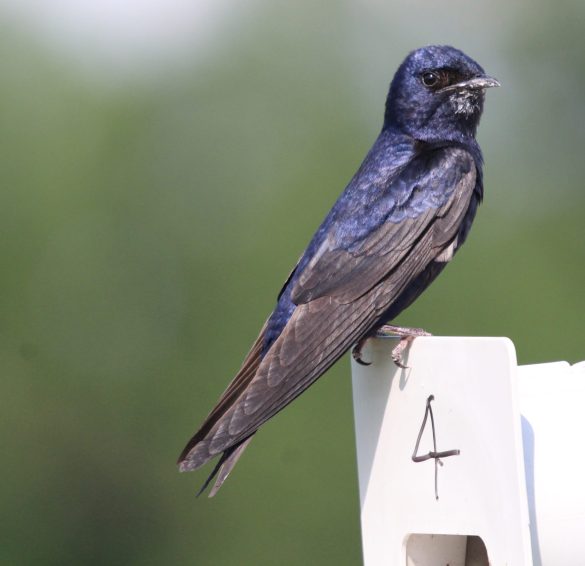
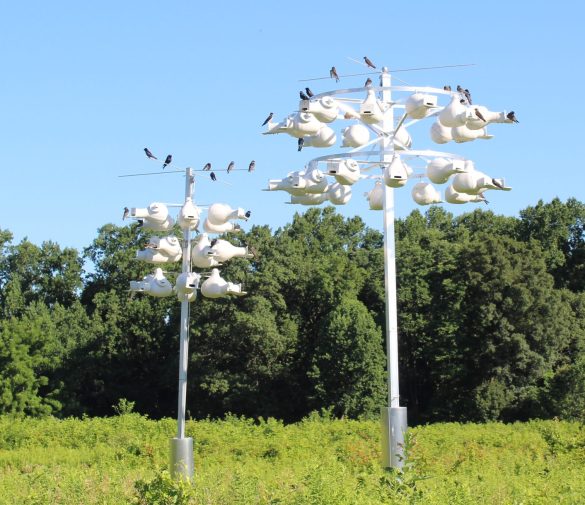
The Purple Martin (Progne subis) is North America’s largest swallow and perhaps the most easily recognizable because they breed in colonies of up to several hundred birds in distinctive houses or racks of gourds. These martin colonies are often found in well-visited public places like state parks or gardens, but some people have attracted them to their own yards by placing the gourds in open areas away from large trees. Since our Purple Martins only nest in artificial housing, erecting gourds is an important way to help these birds which are declining for multiple reasons including a reduction in the insect prey they capture in mid-air. As well as the obvious conservation benefit, establishing a Purple Martin colony is a great way to stimulate an interest in birds because they are very tolerant of people, so adults and children alike can easily observe them feeding their young and enjoy their lively range of chortling and gurgling calls.
This charismatic swallow migrates to Brazil during our winter, and many adults return to breed at the same colony year after year, which is a remarkable feat of navigation and memory for a 50-gram bird (the weight of a half stick of butter)! What is a bigger mystery is where the nestlings settle after they return to North America for their first ever breeding attempt. Some may breed at the colony in which they hatched (known as ‘natal philopatry’) while others may return to the same general area but breed in neighboring colonies. Some could end up at colonies hundreds or even thousands of miles away. Identifying the range of dispersal distances has implications for whether different colonies are relatively inbred or genetically mixed. It could also help new martin ‘landlords’ decide how close to an existing colony they should place a new rack of gourds to maximize their chance of success.
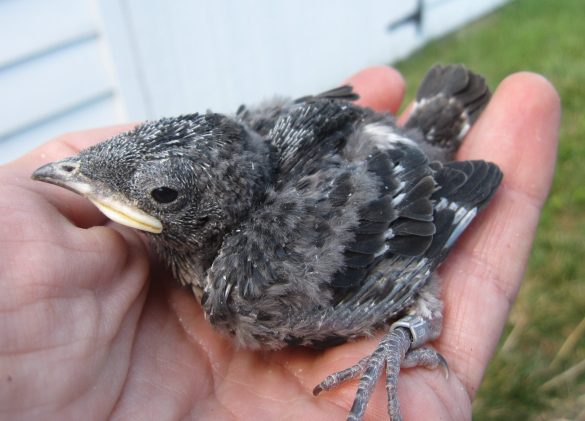
The traditional way of tracking these and other birds is that trained, licensed professionals place a numbered aluminum band on one leg, then if the bird is recaptured by the same or other banders (or unfortunately found dead) one learns about their movements. The Delaware Nature Society has been banding nestling martins at several local colonies for years and we have had several ‘returns’ (birds resighted, recaptured by banders, or found dead). Although it is quite easy to see if a Purple Martin is banded because they tend to sit openly at the entrance to their gourd or on the perching spokes, it can be hard to read all the numbers as they are small.
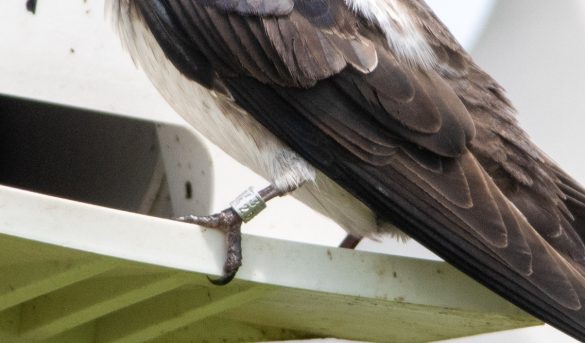
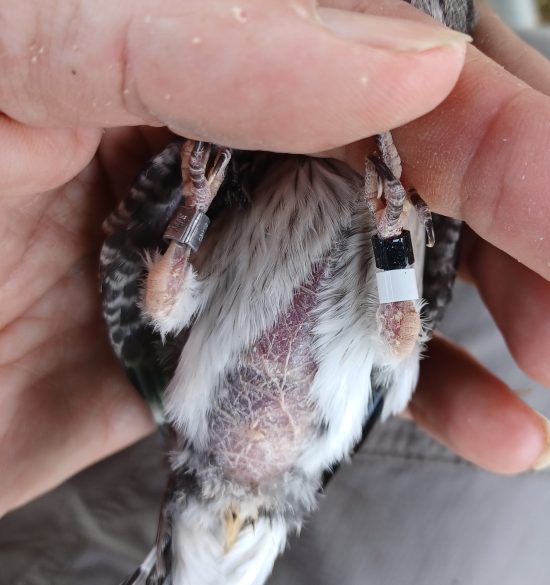
A much more efficient and relatively inexpensive method of tracking birds is to also place colored bands on their legs. These bands are lightweight yet strong and are much easier to see from a distance, so that if you can identify the colors, you have learned something about the bird without having to recapture it. The Delaware Nature Society is involved in an exciting color-banding project organized by the Pennsylvania Game Commission and Dr Jeff Buler of the University of Delaware, and coordinated locally by Will Krohn, a graduate student in Dr Buler’s Aeroecology Lab. All of the nestlings at several local colonies received a combination of color bands that was unique to that colony, so if we spot a color-banded bird and can identify the combination of colors then we know which colony it came from!
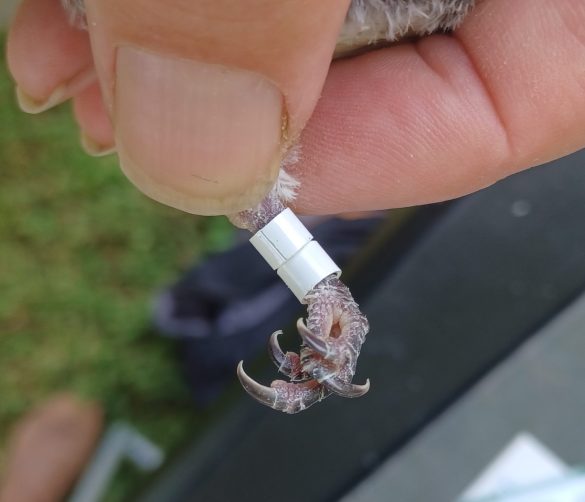
In the summer of 2025, we color-banded Purple Martin nestlings at 4 colonies in southeastern Pennsylvania and northern Delaware. We banded nestlings at Ashland Nature Center in Hockessin DE (118 nestlings), and three sites near Kennett Square PA: Bucktoe Creek Preserve (225 nestlings), Longwood Gardens (63 nestlings) and Kendal-Crosslands Community (72 nestlings). Another 276 nestlings were color-banded at 5 other colonies in south-eastern Pennsylvania by Will and his colleagues at Willistown Conservation Trust, making an amazing total of 754 color-banded nestlings headed to Brazil!
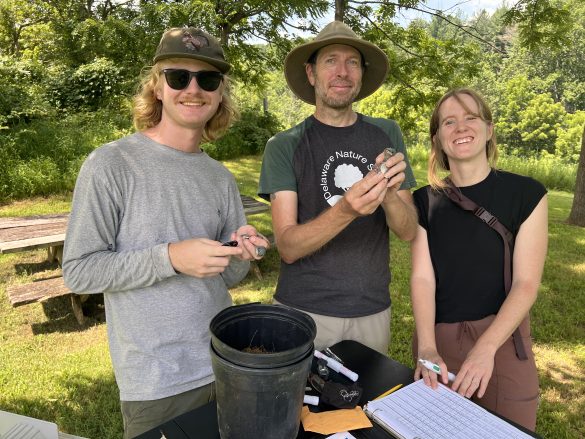
Will and his dedicated field assistants will be spending the rest of the summer scanning local colonies for returning color-banded subadults (birds hatched the previous year) before color-banding another round of nestlings. However, there are many colonies in our area, some of which are either on private property or well outside of his search radius. You can be a part of this intriguing community science project by looking for color-banded Purple Martins at your own colony or any that you happen to visit. Because martins like to sit in open places, legs with color bands can be surprisingly visible with binoculars or even the naked eye. If you are lucky enough to spot a color-banded bird, you can report the findings to Will through this simple form, e-mail him at wkrohn@udel.edu or call him at (484-702-1276). Even if you can’t read the color-band combinations, alerting him to a color-banded bird means he can stop by and try to see it himself. Color-banded nestlings are probably most likely to return to the colony at which they were hatched, so for reference, the color combinations from our local colonies are:
| Colony | Color band combination (top/bottom) |
| Ashland Nature Center | White/White |
| Bucktoe Creek Preserve | White/Black |
| Kendal-Crosslands Community | White/Yellow |
| Longwood Gardens | White/Orange |
Trying to spot color-banded birds is a lot of fun and a relaxing way to spend a sunny morning or afternoon in nature, usually in a beautiful setting. To whet your appetite, one color-banded nestling was seen last week at Bucktoe Creek Preserve – the colony at which it was banded!
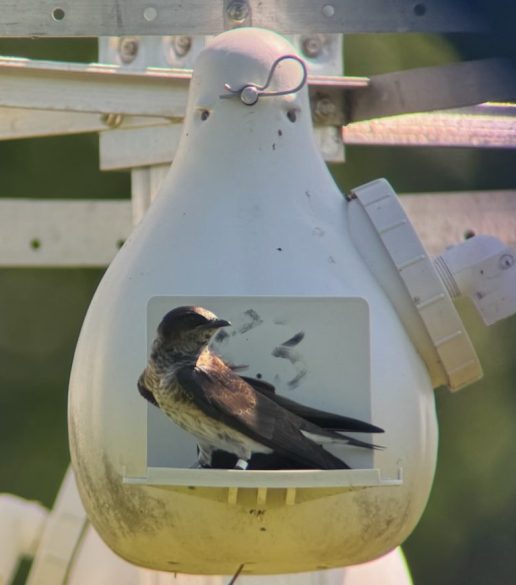
A color-banded Purple Martin recently spotted at Bucktoe Creek Preserve. The combination of a white band above a black band shows this bird was hatched at this colony last year. After it left the nest it flew over 3,000 miles to Brazil then another 3,000 back again!