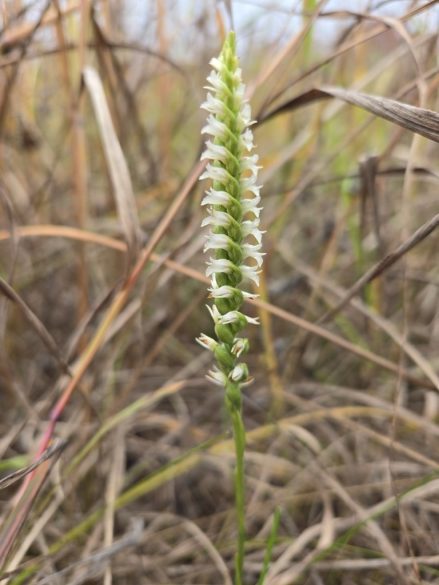
I’m hoping to break the winter doldrums, at least for a moment, with the story of an exciting discovery I made this past fall.
In mid-October, I was working on invasive plant control in an otherwise unremarkable patch of woods dominated by tulip trees. While kneeling on the forest floor to remove multiflora rose, something unexpected caught my eye: a short, twisting stalk studded with tiny white flowers, already past bloom.
I remember thinking, That looks a lot like Spiranthes; a genus of orchid I knew well from cultivated bog gardens. But this didn’t make sense. The Spiranthes I was familiar with grew in wet, open, boggy places. Here I was, standing in a dry, shaded woodland. Could this be a different species?
The timing couldn’t have been better. Just days later, I was scheduled to attend a conference where I knew I’d see Bill McAvoy, Delaware’s recently retired State Botanist. I brought photos with me and showed them to Bill during the meeting. His interest was immediately piqued, and he asked if he could visit the site to see the plants in person.
A week later, we met in the woods to settle the mystery. Bill carefully dug up one individual, both to key it out properly and to press for the Claude Phillips Herbarium in Dover. Within an hour, my phone rang. Bill was calling with the news: the plant was Spiranthes ovalis var. erostellata, commonly known as Lesser Ladies’-tresses, a Delaware first. This marked the first recorded occurrence of the species in the state.
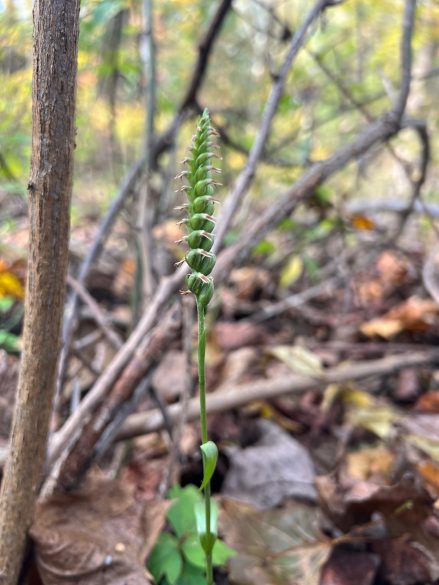
While Lesser Ladies’-tresses is known from neighboring states, it is considered quite rare, with only a handful of documented populations. Bill believes this particular population has likely been here for a very long time. It may have survived the original clearing of the woods, persisted through a period of farmland use, and then endured as the forest slowly regenerated after the land was abandoned.
Its survival may also have been helped, quietly and unintentionally, by years of invasive plant control at this Delaware Nature Society preserve. By reducing competition from Japanese stiltgrass, multiflora rose, and other aggressive non-native species, this rare orchid may finally have had the space it needed to persist, spread, and be noticed.
We are now in the process of installing a deer fence around the population, and I’m already looking ahead to early fall, when we hope to photograph this remarkable new addition to Delaware’s flora in full bloom.